Relator Foundations
Core formulations of Rω = c and proposals for its kinematic basis, including the update-based account of emergent time.
Independent researcher · Fundamental physics
Creator of Relator Theory
“At the boundary of math and reality, I search for the right questions before any answers.”
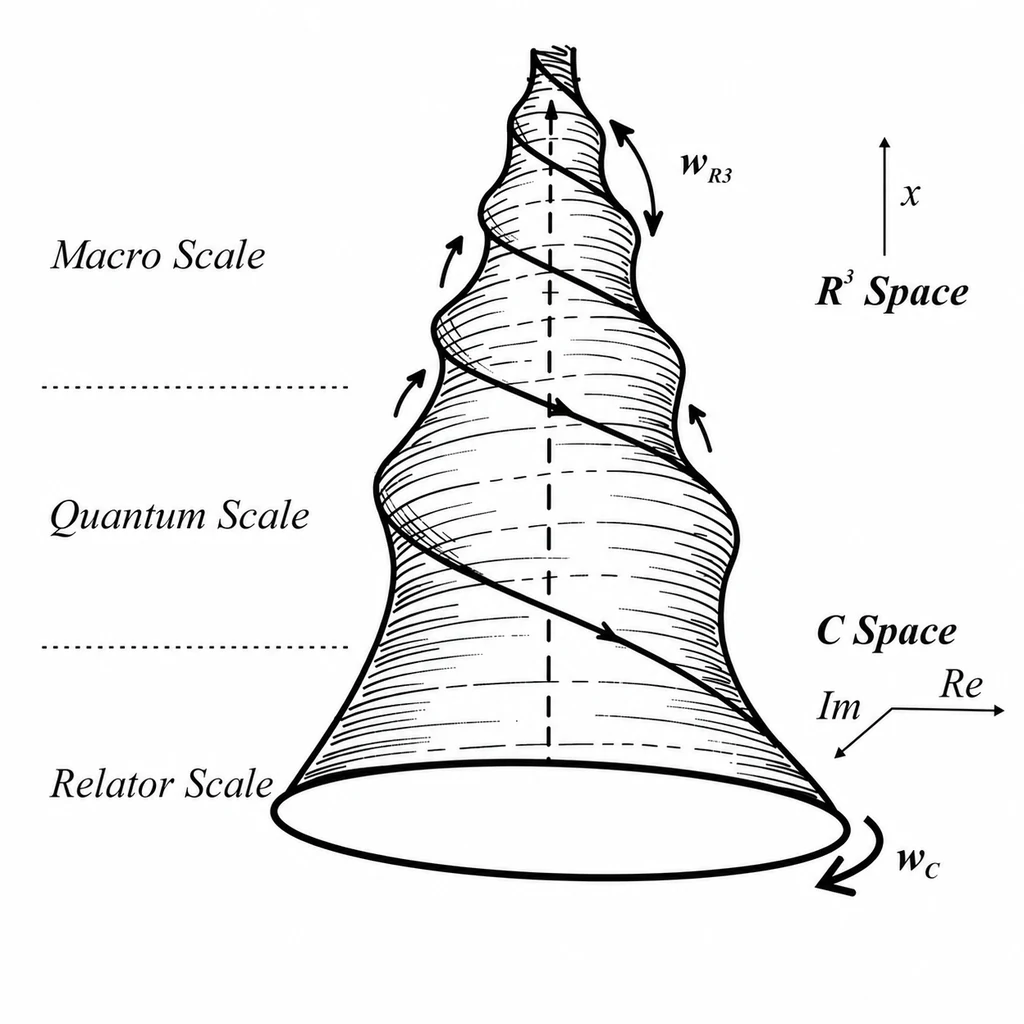
Relator Theory is a proposed two-space framework on C ⊕ R³. In the construction, physical R³ and particle structure are treated as emergent readouts of C-space dynamics under the phase-lock condition Rω = c.
Research program
I have grouped the papers from the Rω = c foundation through C-space geometry and proposed R³ and particle emergence, then to quantum structure, gravity, QED, matter sectors, and fundamental scales.
Core formulations of Rω = c and proposals for its kinematic basis, including the update-based account of emergent time.
Conceptual studies of the complex generator space, Gaussian order, and the internal structure assigned to C before physical readouts are introduced.
Conditional two-space constructions in which physical R³ descriptions or particle properties are read from locked C-space configurations rather than introduced as primitive inputs.
Relator-based proposals for entanglement, spin, helicity, chirality, measurement, uncertainty, and dispersion control in quantum evolution.
Covariant formulations and conditional links to relativistic kinematics, gravity, phase–scale symmetry, and unified electromagnetic–gravitational readouts.
Conditional bridges from the wider C-space program to Dirac–Maxwell/QED descriptions, including proposed closures for α, the electron state and charge coupling, and the boundary-QED electron pole mass. These are model-dependent constructions and audits, not an established derivation of standard QED.
Studies of charged-lepton magnetic anomalies, mass hierarchies, and weak-decay scales—including proposed geometric closures for the Fermi constant—together with neutrino mass hierarchies across the Relator and boundary-QED constructions, with QED or measured values used as external benchmarks where stated.
Conditional studies of proton and neutron structure, light-meson spectra, multi-loop massive-boson states, and collider phenomenology.
Proposed links between C-space statistics, entropy, cosmic age, the Planck scale, and microscopic parameters.
Research outputs
This is the complete publication list. Open any title for a short scientific summary, DOI, and links to the full record.
Browse the publication archive by research area.
Research area
Core formulations of Rω = c and proposals for its kinematic basis, including the update-based account of emergent time.
This preprint proposes the Relator constraint Rω = c as a common kinematic basis for quantum evolution and relativistic effects. It reports derivations of Lorentz time dilation, the relativistic energy–momentum relation, weak-field gravitational time dilation, light deflection, and a Shapiro-type delay, interpreting them as modulation of quantum phase rather than spacetime curvature.
This Letter proposes a discrete state-update rule on the one-complex-dimensional generator space C, from which Rω = c becomes a kinematic consequence and time is counted by update epochs. It also introduces a luminal phase budget and an orthogonal split between internal C rotation and external R³ evolution.
Research area
Conceptual studies of the complex generator space, Gaussian order, and the internal structure assigned to C before physical readouts are introduced.
This preprint takes a normalized Gaussian on C-space to fix an isotropic oscillator normal form whose first level is a U(2) doublet. Conditional on explicit canonical-double, Hopf-readout, and single-speed postulates, it reads that doublet as a spin-1/2 particle–antiparticle one-quantum sector and recovers the standard Wigner representation, Dirac field, and microcausality downstream, while distinguishing the Gaussian width, first-excitation ridge, coherent orbit, and Relator rest-rate scales.
This preprint treats Eguchi–Hanson geometry and Lorentzian spacetime as complementary readouts of finite-width Gaussian states in one-complex-dimensional C-space. Under its stated closure, rate-budget, and transport-soldering postulates, the one-ring sector yields an Eguchi–Hanson state metric and a Lorentzian interval connected as readouts of one state by soldering rather than Wick rotation.
This Letter studies a one-mode squeezing mechanism on the complexified A1 quotient orbit and its role in moving C-space structures toward Eguchi–Hanson/Lorentzian targets. It is presented as a scoped Letter in the C-space geometry thread, proposing a concrete mode-based transition ansatz and tracking its geometric consequences.
This note interprets C as a physical generator space while retaining standard quantum, variational, Gaussian, Maxwell, and infrared Dirac mathematics. It links a Gaussian state on C, its Hubbard–Stratonovich lift into R³, and a locked one-loop electron, treating electron mass as an emergent infrared quantity rather than a bare input.
Research area
Conditional two-space constructions in which physical R³ descriptions or particle properties are read from locked C-space configurations rather than introduced as primitive inputs.
This short note proposes that the wave function is not the microscopic entity itself, but the infrared dynamical R³ readout of an evolving Gaussian creation process in one-dimensional C-space. It frames the familiar quantum state in physical space as an effective description of underlying generator-space dynamics.
This overview presents particles and fields as effective descriptions of locked complex relations rather than primitive objects. It assigns phase to clocking, winding, and electromagnetic holonomy, and positive scale to distance and gravitational deficit, then summarizes proposed links to the fine-structure constant, electron mass, and a three-loop baryonic sector.
This paper formulates a candidate rest-frame closure for electron mass using a locked Gaussian ring across separate generator and propagation spaces. Two independent scalar and vector closure paths yield stationary radii and mass expressions built from the Planck scale, α, and dimensionless geometry; their numerical outputs are compared with the CODATA electron rest energy.
Research area
Relator-based proposals for entanglement, spin, helicity, chirality, measurement, uncertainty, and dispersion control in quantum evolution.
This Letter identifies normalized Relator branch fractions with Dirac–Fierz bilinears, mapping a free Dirac mode to the Bloch geometry of a reduced chiral qubit. It relates the spin-projected spatial fraction to chiral imbalance, the transverse fraction to chirality–spin concurrence, and collinear boosts to a Gudermannian orbit while assigning the generator an ℏ/2 scale; the Gaussian calibration, minimal Dirac operator, and orientation sectors are adopted inputs, and the generator’s formation, stability, microscopic map to spin, and a spin-one massless completion remain open.
Within Relator kinematics, this note combines the Rω = c lock, E = ℏω, and a rotationally symmetric Gaussian energy profile on C. It reports a state-independent energy–time action and an averaged scale of ℏ/2, presenting this as a geometric realization of saturated energy–time uncertainty consistent with Gaussian position–momentum packets.
This Letter introduces a conservative nonlinear modification of single-particle Schrödinger dynamics that represents the Rω = c lock through amplitude–phase coupling. From an effective Lagrangian it derives a real phase potential while preserving norm and standard continuity; numerical simulations report that negative coupling suppresses Gaussian wave-packet dispersion over the tested interval.
This paper introduces Quantum Bifurcation Theory, in which measurement is modeled as an interaction-induced geometric bifurcation constrained by Rω = c. It proposes a joint account of interference and entanglement without explicit collapse or hidden variables, and reports recovery of interference patterns, Bell correlations, Tsirelson’s bound, and no-signaling.
This paper proposes that entanglement emerges from the Relator condition Rω = c in a two-space construction separating internal generator space C from ordinary propagation space R³. It describes interactions as creating a shared internal-frequency component and resonant coupling in C-space, intended as a geometric account of entanglement and the classical–quantum divide.
Research area
Covariant formulations and conditional links to relativistic kinematics, gravity, phase–scale symmetry, and unified electromagnetic–gravitational readouts.
This preprint interprets Einstein’s Hermitian 10+6 tensor as a spacetime readout of a locked transfer from internal C-space. It associates modulus with three-dimensional distance and phase with a U(1) connection, recasts Einstein’s auxiliary restrictions geometrically, and reports that the reduced two-derivative dynamics matches the ADM–Maxwell system.
The paper proposes a local phase–scale transformation that unifies electromagnetic U(1) and gravitational positive-scale gauge branches. From invariant clock and ruler relations plus a Gaussian information cost, it derives a field equation, Newtonian two-body attraction, a lapse–metric relation, and an exact Schwarzschild static vacuum within the stated construction.
Within a conditional Relator construction, the preprint models gravity and electromagnetism as distinct infrared readouts of a shared Gaussian–Coulomb edge kernel on C, with fields represented in R³. It reports recovery of Newton and Coulomb potentials and an Einstein–Maxwell–Dirac reading, subject to explicit refinement, locality, positivity, and normalization assumptions.
This preprint recasts the Relator lock Rω = c and its complex–spatial frequency decomposition within covariant general relativity. It proposes an internal complex fiber populated by an energy-dot ensemble whose maximum-entropy state is Gaussian, then shows how special relativity, gravitational redshift, and the massless sector arise as limiting cases.
Research area
Conditional bridges from the wider C-space program to Dirac–Maxwell/QED descriptions, including proposed closures for α, the electron state and charge coupling, and the boundary-QED electron pole mass. These are model-dependent constructions and audits, not an established derivation of standard QED.
This preprint studies a joint emergence scheme for the electron fine-structure coupling, mass, and anomalous magnetic moment within QED on Eguchi–Hanson space. It brings the α, boundary-mass, and g−2 strands of the C-space-to-QED program into a single geometric construction rather than treating these electron constants as unrelated primitive inputs.
This preprint studies α within a boundary-QED construction on Eguchi-Hanson geometry, continuing the C-space to boundary-QED thread. It frames the coupling as a proposed emergent quantity tied to geometric and topological inputs rather than a primitive input.
The full preprint derives an electron-mass formula from massless QED coupled semiclassically to Euclidean Einstein gravity on Eguchi–Hanson space. A spin structure, Gaussian source profile, boundary location, radial response, and one binary homogeneity axiom define the construction; radial stationarity yields a one-loop estimate compared with the observed mass only as an audit.
This Letter studies a Planck-cutoff QED–Dirac–Maxwell boundary problem in which an Eguchi–Hanson Maxwell action fixes an exponential factor. Balancing fixed-charge and collar-stiffness terms determines a stationary radius and an electron-mass estimate; the abstract reports reduced-branch and one-loop-audited values without using the observed electron mass as input.
This note recasts the broader Alpha/Relator route as a conditional Dirac–QED finite-part closure for the fine-structure constant using standard Dirac/QED ingredients plus five explicit nonstandard assumptions. With no measured α or continuous fit parameter inserted, a reduced audit matches CODATA closely; an error-bounded transverse-photon resolvent evaluation remains necessary for full certification.
This paper proposes a conditional shell-geometric mechanism that selects the fine-structure coupling from an Rω = c lock, pinned electron branch, scalar slowdown law, vector shell geometry, and a universal logarithmic coefficient. It reports a value near the accepted benchmark and derives a related pure-photonic electron g−2 series as a cross-check.
This note formulates the Relator electron as a stationary-action problem on C ⊕ R³ and connects the result to Dirac and special-relativistic infrared physics. Its variational locks are said to determine electron mass without an inserted mass parameter; phase gauging supplies charge and Maxwell coupling, while a Pauli term accommodates g−2.
Research area
Studies of charged-lepton magnetic anomalies, mass hierarchies, and weak-decay scales—including proposed geometric closures for the Fermi constant—together with neutrino mass hierarchies across the Relator and boundary-QED constructions, with QED or measured values used as external benchmarks where stated.
This Letter condenses the proposed boundary-QED decay mechanism into formulas for the Fermi constant and charged-lepton decay scale. A minimal A₁→A₂ transition action, gravitational boundary Hessian, and Z₃ Hesse factor leave one dimensionless quantum response Q; at Q = 1 the reported muon lifetime is 2.19413 μs and the Fermi constant is displaced by 649.7 ppm from the muon extraction, so the result is presented as a scale-setting mechanism rather than an all-orders precision prediction.
This full preprint proposes that the charged-lepton weak-decay scale emerges from a boundary-QED construction in which an electron-flux state on Eguchi–Hanson A₁ crosses the minimal A₁→A₂ ALE bridge. It factorizes the Fermi constant into α, Newton’s constant, geometric factors, and an unevaluated dimensionless response; the unit-response benchmark reproduces the muon lifetime to 0.13% and leptonic tau widths to 0.3%, while the paper leaves that response and parity violation underived.
This preprint defines a source-descended boundary-QED sector in which equal-charge Dirac branches acquire unequal masses while retaining their common charge, spin, and Thomson coupling. A frozen evaluator, using no heavy-lepton mass as input, yields muon/electron and tau/electron mass ratios of 206.7682846913 and 3477.221303666; because the source map is defining data and extension to an unrestricted all-orders parent remains open, the values are presented as exact sector benchmarks rather than physical predictions.
This paper derives a closed charged-lepton mass-ladder law in which the electron, muon, and tau are treated as three shell realizations of one Gaussian Relator core. Shell-dependent source terms pass through a determinant-normalized Schur/Feshbach construction before producing mass logarithms; it reports electron-anchored muon and tau ratios without fitting those masses.
This paper presents a finite electromagnetic-sector Relator calculation of charged-lepton g−2, treating the anomaly as the magnetic image of self-field-induced internal-clock slowdown rather than an independent Pauli term. A universal shell branch is combined with lepton-mass-dependent source-covariance terms, and the resulting coefficients are compared externally with pure-photonic QED benchmarks.
This paper extends the charged-lepton Relator construction to normally ordered neutrino masses using a ring–collar geometry fixed by Rω = c. With coefficients obtained from analytic series and one-dimensional integrals, it reports mass ratios and a mass-squared-splitting ratio, then compares them with global-fit values while stating that no neutrino data enter the construction.
Research area
Conditional studies of proton and neutron structure, light-meson spectra, multi-loop massive-boson states, and collider phenomenology.
This Letter models the light pseudoscalar octet as geometric states of a charge-one Eguchi–Hanson sector. A minimal rank-three source bundle extends the intrinsic A₁ geometry to an oriented A₂ algebra, and a positive Hodge–Stieltjes law yields leading-order pion, kaon, and η₈ masses from α(0) and the reduced Planck mass without meson or quark masses, a hadronic scale, or fitted channel coefficients; the construction depends on its adopted geometric and spectral assumptions, while radiative contact corrections and the full meson-sector stationary problem remain open.
This full preprint derives an electroweak-boson sector from a single renormalized massless-QED functional on a marked A₁→A₂ Eguchi–Hanson bridge. Its closed parent fixes an electroweak scale, mixing angle, particle multiplicities, charges, spins, local vertices, and tree-level W–Z–H masses; a resolved light-sector O(α) transport moves the W and Z masses toward measured values without fitted bosonic parameters, but three finite one-loop parent responses remain undetermined by the Thomson and Ward conditions, leaving the net hard radial response and a completed precision prediction open.
This full preprint develops a charge-one boundary-QED model on Eguchi–Hanson space with a C₃-symmetric Hesse source. It compares primitive N = 1 and minimal conjugate-pair N = 3 sectors through Calderón–Feshbach reduction and radial stationarity, obtaining mₚ/mₑ = 1836.1527612(21) on a declared round branch without measured proton or electron masses or fitted junction coefficients; non-round remainders remain explicit, and the result is not presented as an all-orders, theory-error-bounded prediction.
This Letter proposes a closed proton–electron mass-ratio formula within a specified charge-one boundary-QED branch on Eguchi–Hanson space. A singular C₃ Hesse junction changes the stationary collar scale while a first-order spinorial neck preserves the dimensionless pole; the reported value is 1836.1527612(21), 0.0478 ppm above CODATA, without a proton-mass input or fitted sector coupling, and the paper bounds the first source-local pair-channel correction.
This Letter defines a recastable Relator-Z₅ charged-vector benchmark for LHC searches, centered on a 10.7707 TeV spin-1, unit-charge state and a heavier partner near 22 TeV. It identifies interference in the high-MT charged-current Drell–Yan tail as the main observable, conditional on unresolved geometric overlap and interference parameters.
The preprint replaces a scalar Z₃ triplet junction gate with a bounded projective Hesse construction on CP². Under stated shell-admission and spectral-matching assumptions, it gives conditional formulas for a proton-candidate/electron mass ratio and charge spacing, plus a reduced geometric proton g-factor estimate, while withholding a full baryonic magnetic derivation.
The preprint extends the Relator closure to a Z₄-locked four-loop bouquet, which it claims selects an electroweak-scale parent and a parameter-free W–Z–H mass triad. It associates topology with dominant couplings and decay channels, and predicts a heavier Z₅ rung that could yield new resonance scales at sufficiently energetic collisions.
The preprint models a neutron as a lock between a Z₃-stabilized proton junction and a one-loop lepton. Using the Relator phase budget, Gaussian collar, measured neutron g-factor, and PDG/CODATA inputs, it formulates an invariant “attempt × gate” decay rate and reports a mean lifetime of 877.83 s.
This Letter extends the one-loop Relator construction to a Z₃-locked three-loop bouquet as a proton candidate. Without introducing QCD microphysics or fitted couplings, it derives a closed proton–electron mass-ratio estimate while explicitly acknowledging omitted composite microstructure; the reported value exceeds the CODATA ratio by about 405 ppm.
Research area
Proposed links between C-space statistics, entropy, cosmic age, the Planck scale, and microscopic parameters.
The preprint asks whether entropy can arise from the algebra of a one-dimensional complex generator space. Assuming luminal “energy dots,” symmetry, additivity, and a fixed information-update rate, it argues that Shannon entropy and a circular Gaussian distribution follow, interpreting entropy as a statistical expression of the underlying complex structure.
This Letter reports a numerical conjecture relating the Planck length, electron and Planck masses, and a cosmic radius derived from the Universe’s age. The proposed scaling links microscopic and cosmological quantities, but the abstract explicitly states that it lacks an established microscopic derivation and does not yet constitute a complete physical theory.
Correspondence
This is an independent theoretical program, and I welcome serious discussion about its mathematical consistency, physical assumptions, and testable consequences—especially in quantum foundations, gravitation, and particle structure.